javaride.com – Every rider who messages me before a trip asks some version of the same question: what bike should I bring, or what bike should I book? And almost every one of them is thinking about it wrong — because they’re picturing Java as one terrain, and it isn’t. It’s five terrains stacked into a single day, and the bike that wins on one of them can be a liability on the next.
I’ve watched riders show up convinced that more displacement solves everything, and I’ve watched that same confidence evaporate somewhere around hour four, standing knee-deep in volcanic ash, trying to figure out how a 220kg motorcycle got itself sideways in sand that looked completely rideable from a distance.
Java Doesn’t Give You One Terrain — It Gives You Five in a Day
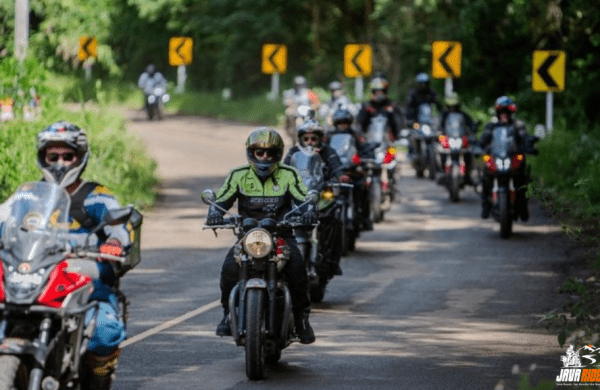
Start early on smooth tarmac cutting through a mountain pass, cool air, easy triple-digit speeds if the road allows it. Two hours later you’re picking a line through a rice-paddy access trail barely wider than your handlebars, embankments dropping off on both sides, water buffalo not moving for anyone. By midday you’re on the lower slopes of a volcano — not solid ground, not sand exactly, more like a surface that decides on its own whether it wants to support your weight. Afternoon brings a river crossing that wasn’t there on the map, because the map was drawn before this week’s rain. Evening is jungle switchbacks, tight, off-camber, roots across the trail right where you need traction most.
That’s not an exaggerated route description — that’s a fairly ordinary day riding through Java’s interior. The terrain doesn’t ease you in. It tests a different skill and a different bike characteristic roughly every ninety minutes.
Why the Bike You Bragged About at Home Might Struggle Here
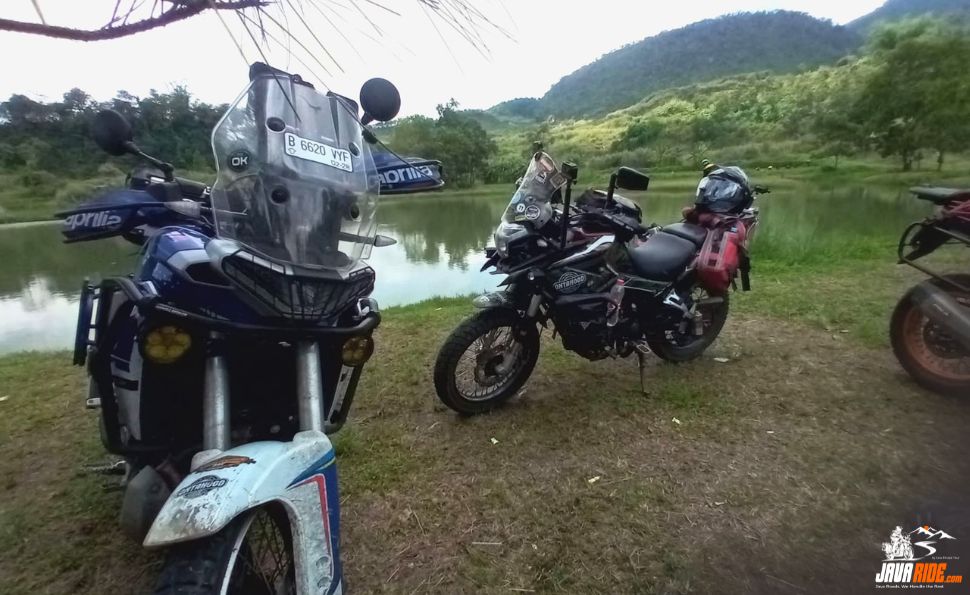
Big-bore adventure bikes — the 850s, the 1200s, the machines that feel unstoppable on a fire road back home — carry real weight into terrain that punishes weight. When one of those goes down in soft volcanic sand or in the mud lining a paddy trail, picking it up alone, in humidity that has you sweating through your jacket by 9am, is a genuinely different problem than dropping a lighter bike on a groomed trail.
It’s not that a big ADV bike can’t do it. Riders do it, and do it well, especially with a support crew and the skill to match. But the calculus changes completely once you’re off tarmac and onto ground that shifts under you. Tight switchback turns on narrow embankments don’t forgive a long wheelbase and a high center of gravity the way an open fire road does.
The Mid-Weight Dual-Sport Sweet Spot
This is why so much of Java’s best riding gets done on bikes in the 250–450cc dual-sport class — machines light enough to muscle through sand and mud without a second rider, agile enough for single-track that a bigger bike would have to fight, and still enough motor to hold a decent pace on the tarmac links between trailheads.
These bikes don’t win on a spec sheet next to a liter-class ADV machine. They win on the actual terrain, in the actual conditions, on the actual day described above — which is the only comparison that matters if you’re the one riding it.
When a Full-Size ADV Still Makes Sense
None of this means leave the big bike at home categorically. If your route leans heavily toward tarmac and graded gravel, if you’ve got real off-road hours logged, and if there’s a support vehicle behind you for the moments it goes wrong — a full-size ADV bike is absolutely capable across Java. The honest answer isn’t “always ride small,” it’s “match the bike to the specific route and the support behind you,” which is a very different conversation than most riders are having when they ask about displacement.
The Bike Is Only Half the Equation
Tire choice changes everything a spec sheet promises — a knobby-heavy setup transforms how a bike handles volcanic sand and river crossings, while a 70/30 street-biased tire will fight you the entire time. Suspension setup, tubeless conversions for puncture resistance out where the nearest tire shop is hours away, and a mechanic who actually knows the model in front of them — all of that does more for your day than the number stamped on the engine case.
And honestly, the thing that matters more than the bike itself is knowing which river crossing is passable this week after rain, which mountain pass has a landslide repair crew working on it, and which volcanic track turns to unrideable paste by 2pm versus which one stays firm all day. That’s not information on a spec sheet. That’s route knowledge built from riding the same ground for years, not months.
So What’s the Actual Answer
There isn’t a single “best” motorcycle for Java — there’s a best motorcycle for your specific route, your skill level, and the support you’ve got behind you. Anyone giving you a flat one-bike answer hasn’t ridden enough of the island to know how much it changes block to block.
That’s exactly the reason JavaRide doesn’t hand every rider the same machine and wish them luck. Every trip is fully-supported, start to finish — the right motorcycle for the route, proper gear, a support vehicle, a towing vehicle, and a mechanic riding with you, not waiting at a shop two hours away. Every trip is also private and fully customized, whether that’s a solo rider, a group of friends, a company outing, or a visiting motorcycle club that would rather skip the hassle and cost of shipping their own bikes across an ocean.
Our road captains have logged the terrain, the weather patterns, and the communities along these routes for years — not weeks — and that experience sits on top of more than a decade of Java Private Tour’s operational track record across Java, Bali, Lombok, and Flores. We’re not a generalist adventure-moto operator spreading itself thin across the whole archipelago. We’re specialists in Java specifically, with route depth and local cultural access that a generalist simply hasn’t built. If you’re an international rider looking at Java for the first time, that’s the difference between guessing at bike choice from a forum thread and having someone who’s ridden the exact ground tell you straight.
So, if you’re ready to ride the terrain that actually decides which motorcycle is right for you, head over to our contact page and let’s start planning your route. Or you can simply CLICK THIS LINK to chat with us on WhatsApp. With JavaRide, you’re not just getting a bike and a route — you’re getting fifteen years of local knowledge behind every mile. See you on the road!