javaride.com – Your first ten minutes on a Javanese road will rewrite everything you thought you knew about traffic. Not because it’s more dangerous than you expected, and not because it’s more chaotic — though it looks that way from the back of a car window. It’s because the entire logic of the road is different, and nobody bothered to translate the rulebook before you got here.
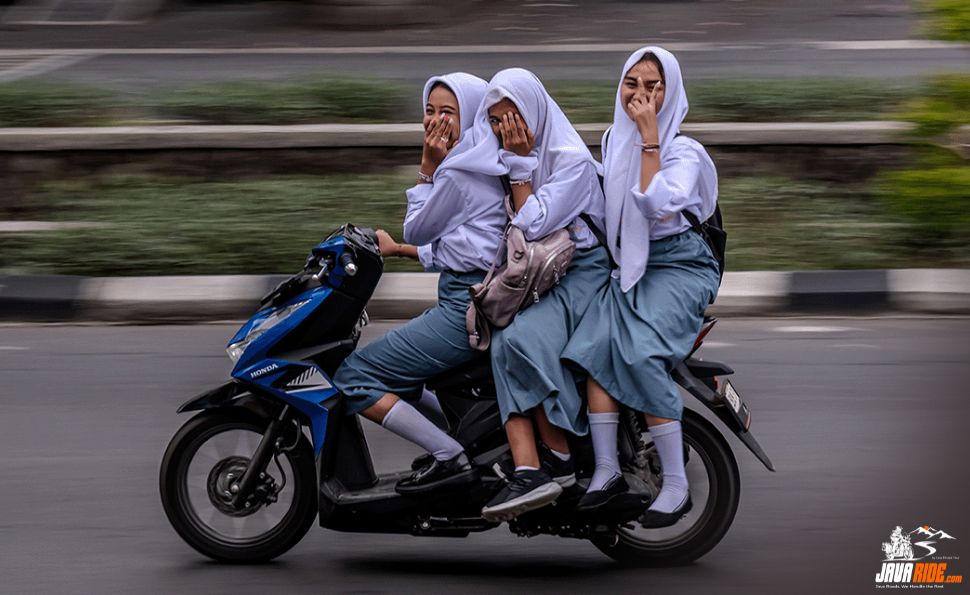
You’ll see a family of three balanced on a single 125cc scooter, weaving through a gap that looks barely wide enough for one bike, let alone three people. You’ll see a kid who can’t be older than twelve, backpack on, phone wedged against the mirror, cutting into a lane like he’s done it a thousand times — because he has. You’ll sit in gridlock so total that nobody moves for ten minutes straight, and notice something missing: nobody’s leaning on their horn. Nobody’s yelling out the window. It’s just quiet, patient stillness, engines idling, everyone waiting their turn like it’s the most normal thing in the world.
This is the part of riding in Java that no spec sheet or route map prepares you for. The terrain is one thing — you can train for hills, sand, river crossings. The traffic culture is a different kind of skill, and reading it correctly is half of what makes a foreign rider blend in instead of stick out.
Three People, One Motorbike
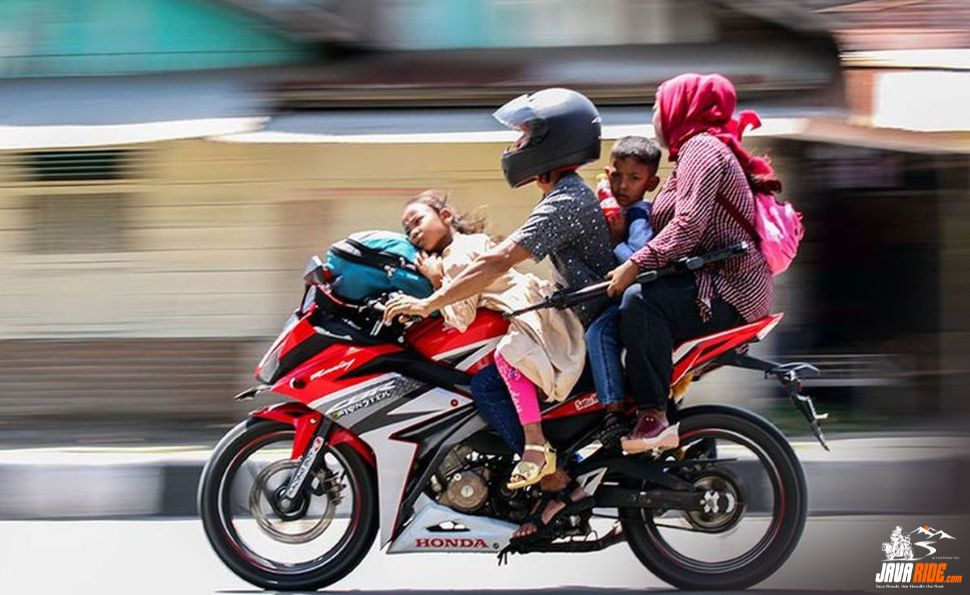
The first time you see it, you’ll probably reach for your phone to take a photo. Mom driving, toddler wedged between her knees and the handlebars, dad on the back holding a folded umbrella like it’s cargo. Three-up riding, known locally as gonceng bertiga, isn’t a party trick or a stunt for social media — it’s how a lot of families actually get from one place to another when a car isn’t in the budget and the nearest bus stop is forty minutes away.
It’s worth being honest about what this is: it’s a workaround born out of necessity, not a safety standard anyone would recommend, and it’s not something a visiting rider should try to replicate for the novelty of it. What it tells you, though, is something real about how central the motorbike is to daily life here. It’s not a weekend toy. It’s the school run, the grocery run, the way half a village gets to a wedding on the same afternoon. Once you understand that, the way people ride around you — the tight spacing, the confident lane-splitting, the apparent disregard for what you’d call “personal space” on two wheels — starts to make a lot more sense. Everyone’s read the same unwritten manual since they were old enough to hold on.
A Twelve-Year-Old Just Overtook You
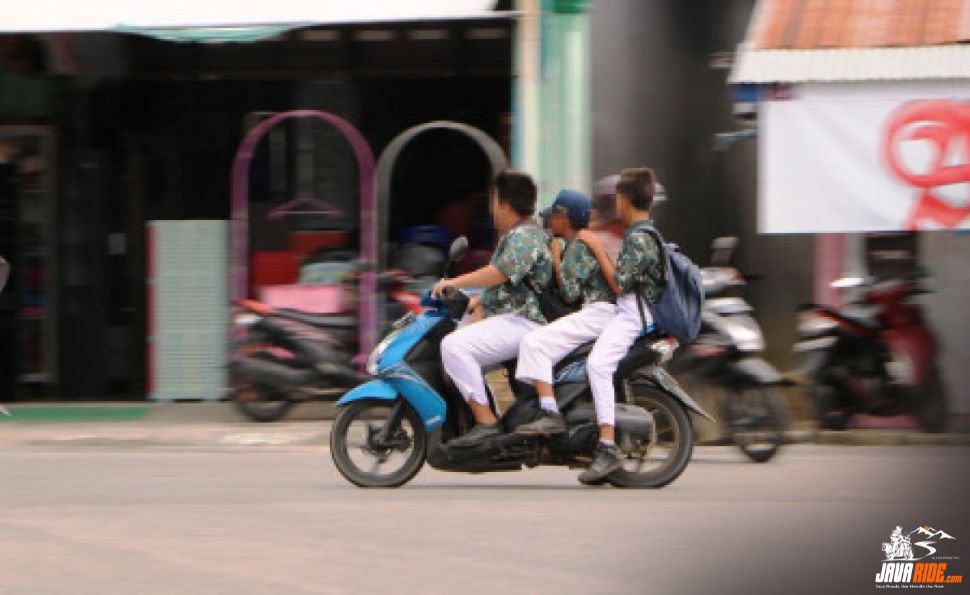
Somewhere on a secondary road outside a market town, a kid too young to legally hold a license anywhere in the West will pass you like you’re standing still, matic scooter buzzing, no helmet, sandals instead of boots. It happens often enough that after a few days it stops registering as unusual — which is exactly the moment you need to remind yourself it still is.
Rural and semi-rural Java runs on informal transport logic that predates any traffic law currently on the books. Kids ride to school, to the fields, to a friend’s house, because the alternative is a long walk and there’s no school bus coming. It’s a reality of local life, not an invitation. For an international rider, the lesson isn’t “join in” — it’s “expect the unexpected, from every direction, at every speed.” A scooter can appear from a side alley with a rider who’s never taken a defensive-driving course in their life, and your job is to have already clocked that possibility before it happens, not after.
Gridlock Without the Rage
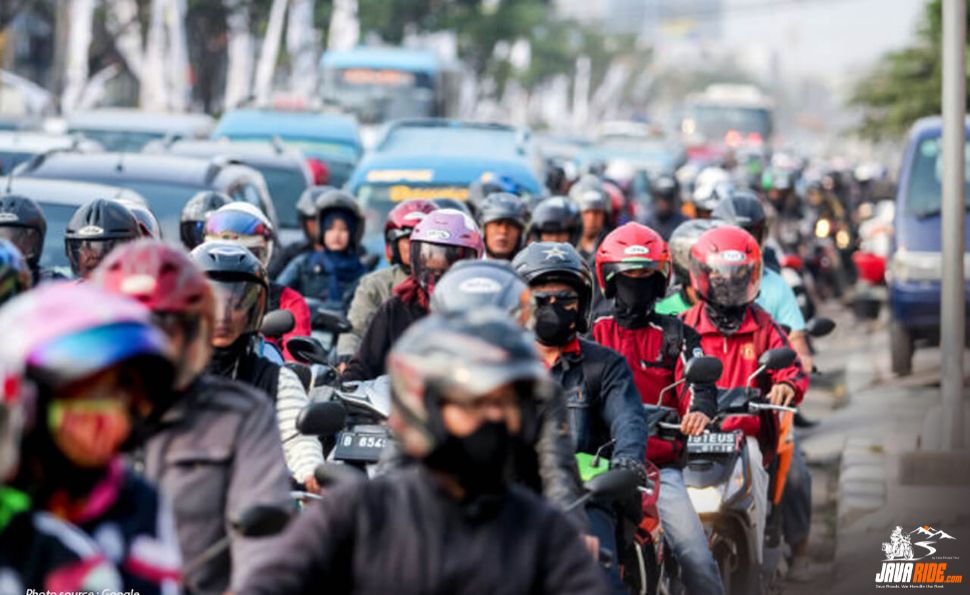
Here’s the part that actually surprises people the most, more than the three-up riding, more than the kids on scooters: Java does gridlock without road rage. Sit in stopped traffic in a lot of major cities around the world and you’ll get a symphony of horns within thirty seconds — frustration performed loudly, aimed at nobody in particular. Sit in the exact same standstill outside Yogyakarta or Malang, and you’ll mostly get silence. Engines idling, riders checking their phones, someone adjusting a kid’s helmet, a food cart weaving through the gaps selling snacks to people who are, by any other country’s standard, extremely stuck.
Horns here aren’t insults. A short tap means “I’m here, I’m passing on your left,” not “get out of my way, idiot.” It’s communication, not confrontation. There’s a patience baked into the culture that treats a traffic jam as weather — something you sit through, not something you fight. For a rider used to aggressive city traffic elsewhere, unlearning the urge to get frustrated is one of the first real adjustments. The road isn’t trying to beat you today. It’s just full.
Reading the Chaos
Once you stop bracing for confrontation, you start noticing the actual rules underneath what looks like disorder. Bigger vehicles get right of way by default, not by law but by consensus. Merging happens by eye contact and a slight roll of the throttle, not by signaling and waiting for a gap. Lanes are a suggestion on a two-lane road that regularly functions as four. None of it is written down. All of it is learned by watching, and it takes a local road captain who’s spent years reading these signals to translate it fast enough that a visiting rider doesn’t spend their whole trip white-knuckled.
Why Ride This With Someone Who Already Speaks the Language of the Road
This is exactly the gap JavaRide (by Java Private Tour) exists to close. We’re not a generalist adventure operator running the same playbook across a dozen countries and hoping it translates. We’re Java specialists — every route, every backroad shortcut, every read on how local traffic actually moves has been built from more than fifteen years working this island specifically, not skimmed off a map the week before your trip.
Every JavaRide trip is fully-supported from start to finish: motorcycle, gear, a support vehicle, a towing vehicle if something goes wrong, and a mechanic on every route — so the only thing you have to focus on is riding, not logistics. And every trip is private and built around who’s actually riding: a solo rider chasing the terrain, a group of friends who want to do this together, a corporate outing that needs to run like clockwork, or a visiting motorcycle club that doesn’t want the hassle of shipping bikes across an ocean.
Our road captains aren’t reading the traffic culture for the first time alongside you — they’ve spent years learning exactly what a horn tap means, when a gap is real and when it isn’t, and how to keep a group of international riders moving safely through conditions that would otherwise take weeks to get comfortable with. That’s the difference between watching Java’s traffic from the outside and actually riding through it like you know where you’re going.
So, if you’re ready to ride through everything that makes Java’s roads unlike anywhere else you’ve ridden, head over to our contact page and let’s start planning your route. Or you can simply CLICK THIS LINK to chat with us on WhatsApp. With JavaRide, you’re not just getting a bike and a route — you’re getting fifteen years of local knowledge behind every mile. See you on the road!