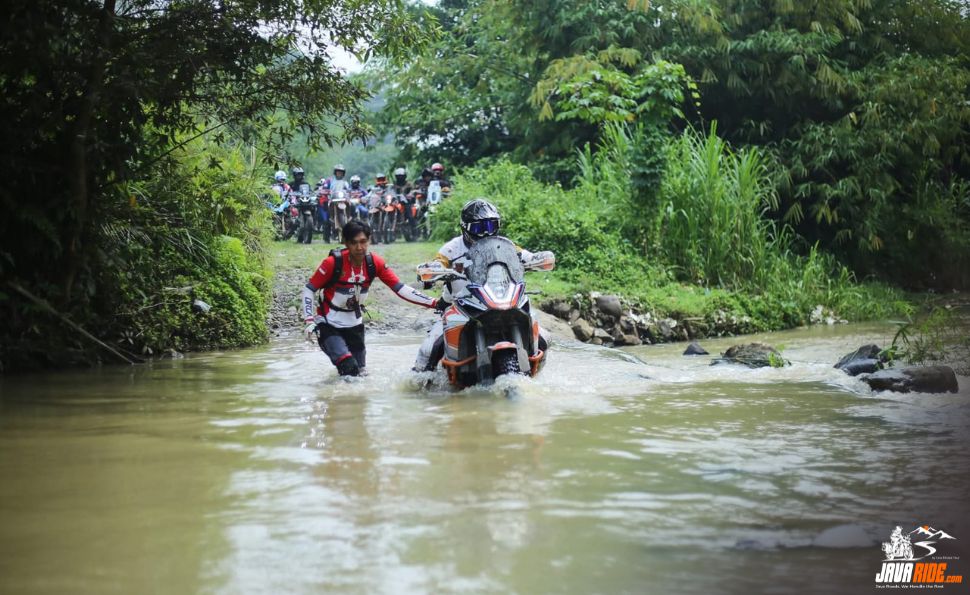
javaride.com – You see it from fifty meters out: a brown ribbon of water cutting across the track, maybe knee-deep, maybe not. In dry season this same spot is a non-event — you’d barely stand up on the pegs. In wet season, it’s the moment that decides whether the rest of your day happens on schedule, gets rerouted, or ends with you and three other people pushing a stalled bike against a current that’s stronger than it looks from the saddle.
River crossing motorcycle Java routes get romanticized in trip reports and Instagram reels — spray off the front wheel, everyone grinning under a poncho. What doesn’t make the reel is the five minutes before, when someone has to actually read the water and decide whether today’s crossing is a photo op or a problem. That decision-making is the part worth understanding before you’re the one standing at the edge with the throttle in your hand.
Why Java’s Rivers Don’t Play Fair in the Wet Season
Most of the rivers you’ll cross on a dual-sport route Indonesia riders take through West Java start high — volcanic slopes with steep, short catchments. That geography matters more than the rainfall total for the day. A river can rise well before the rain reaches you, because the water fell an hour ago on a slope ten kilometers upstream and it’s arriving now. You can be standing under a clear patch of sky at a crossing that’s rising by the minute, and there’s no way to tell just by looking at your own weather.
This is the single biggest misread new riders make on an offroad motorcycle route Java trip during wet season: judging the crossing by the sky overhead instead of the water in front of them. The water doesn’t care what your sky looks like. If you crossed the same ford an hour ago and it was fine, that tells you nothing about whether it’s fine now — volcanic terrain sheds water fast, and levels move in a way that flatland rivers back home usually don’t.
Reading a Crossing Before You Commit
A good crossing read isn’t a gut feeling, it’s a short checklist you run every time, even on a route you’ve done before. Current line first — is the fastest-moving water pushing straight across, or angled downstream in a way that’ll walk your front wheel off line mid-crossing? Water color and opacity next — clear water lets you see the bottom and judge depth and rock placement; opaque brown water means you’re crossing blind and need a walked line first, not a ridden guess. Then submerged rocks: watch how the surface moves around them. A rock that’s causing a visible boil or standing wave is shallower and the water’s moving faster around it than it looks from a distance.
If there’s a warung or a house near the crossing, the people living there know that river better than any of us ever will. Asking “sudah bisa lewat?” — can it still be crossed — before committing is not a sign of inexperience, it’s the fastest, most reliable read available, and it costs you thirty seconds.
The Mistakes That Get Riders Stuck
Three patterns account for most of the trouble we see. First, entering too slow and losing momentum in the deepest section, which is exactly where you need it most. Second, fixating on the far bank instead of reading three meters ahead, which means you react to a rock or a drop-off a half-second too late. Third — and this is the one that actually strands bikes — treating a river that was fine on the way out as automatically fine on the way back, hours later, after rain fell somewhere you never saw it.
What Actually Happens When It Goes Wrong
A stall mid-crossing isn’t dramatic in the moment — the engine just stops, the current keeps pushing, and now you’re standing in moving water holding up a bike that’s suddenly much heavier than it was on land. Water finds its way into the airbox faster than most riders expect, especially on bikes without a raised intake, and once that happens the bike isn’t restarting until it’s out of the water and dried out, not just tipped upright.
Getting a stalled bike out of a current alone is a genuinely hard physical task — you’re fighting the water’s push, the bike’s weight, and an unstable riverbed all at once. This is where riding with a support vehicle and a mechanic on every leg stops being a nice-to-have and becomes the actual difference between a fifteen-minute delay and a multi-hour ordeal, especially on a route where the nearest outside help is a long way off.
The Gear and Setup That Matter Here
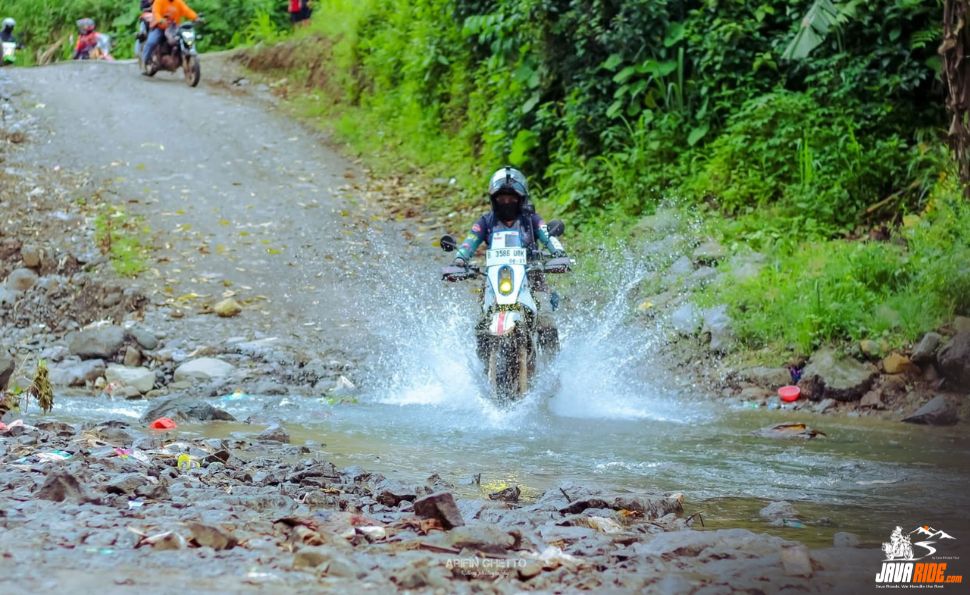
Snorkel height gets a lot of internet attention, but on the crossings we’re talking about — knee to thigh deep on a standing rider — intake height rarely decides the outcome. Line choice does more work than gear does. What matters more in practice: electricals sealed and taped, not just factory-stock; tires suited to a wet, often algae-slick riverbed entry and exit rather than optimized purely for dirt; and a rider who’s walked the line, not guessed it, before committing the front wheel.
Riding This With People Who Know the Water
None of this is a reason to skip river crossings on a Java itinerary — they’re one of the more memorable parts of riding this terrain, and the moment usually earns its place in the trip report. It’s a reason to ride them with people who’ve read this exact water before, in this exact season, and who have a support vehicle and towing capability behind them if the read turns out wrong.
That’s the gap between a generic regional operator and a specialist. An operator running trips across the whole archipelago sees a given West Java river maybe once a season. A team that rides Java’s terrain as its core focus knows which crossings shift after heavy rain, which villages have someone worth asking, and which routes have a dry alternative built in for exactly this scenario. That depth doesn’t show up in a route map — it shows up in the moment you’re standing at the edge of the water deciding what to do next.
This is what fully-supported actually means on a JavaRide trip: a motorcycle, gear, a support vehicle, a towing vehicle, and a mechanic on every route, not just the ones marked difficult. Every trip is private and built around who’s riding — a solo rider working through a bucket-list route, a group of friends, a company outing, or a visiting motorcycle club that would rather not deal with shipping bikes into Indonesia. Our road captains ride this terrain year-round, so they know how these rivers behave in November versus how they behave in July, and that’s backed by more than fifteen years of Java Private Tour’s operational experience across Java, Bali, Lombok, and Flores. If you’re planning a first Java crossing, the value isn’t in reading a checklist like this one — it’s in riding next to someone who’s already made every mistake on this list, so you don’t have to.
So, if you’re ready to ride Java’s river crossings the way they’re meant to be ridden, head over to our contact page and let’s start planning your route. Or you can simply CLICK THIS LINK to chat with us on WhatsApp. With JavaRide, you’re not just getting a bike and a route — you’re getting fifteen years of local knowledge behind every mile. See you on the road!