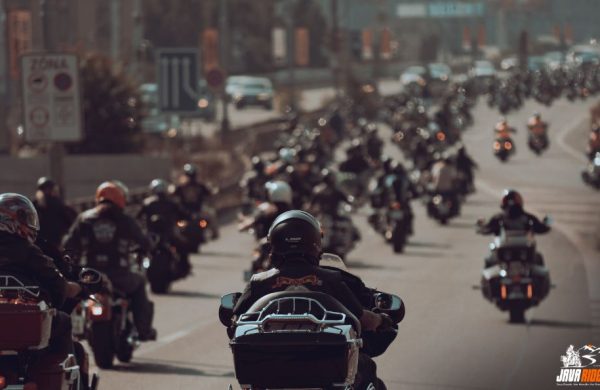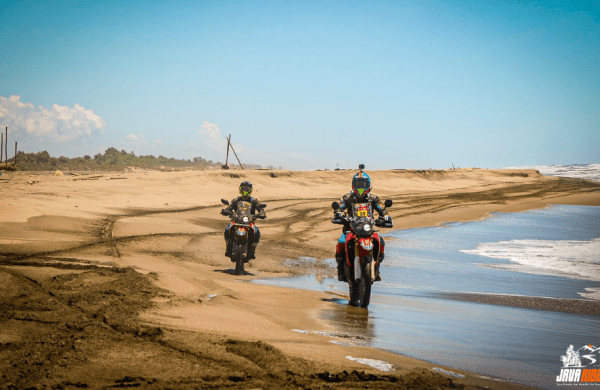
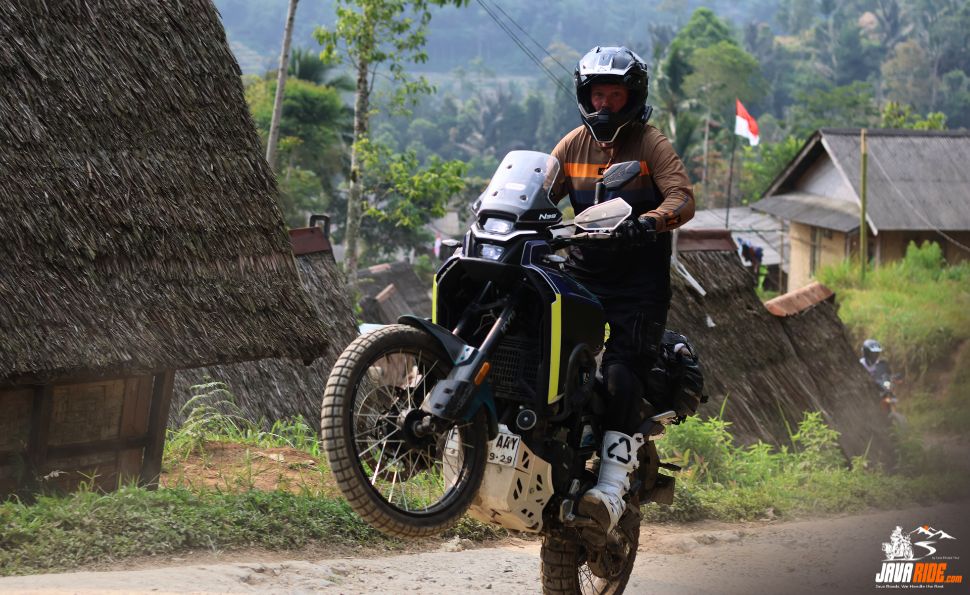
javaride.com – Every motovlogger has a version of this story. You find a route online, the thumbnail looks incredible, you build a shoot day around it — and then you get there and the sun’s behind the ridge until 10am, the road’s one lane wide with trucks coming the other way, and there’s nowhere to pull over without putting your front wheel in a ditch. The scenery was real. The footage still came out flat, backlit, and shaky, because scenery and shootability aren’t the same thing.
Riders picking a route for the view ask one question: is it beautiful. Riders scouting motorcycle routes for motovlogging ask a different set — which way does the light fall at the hour they’ll actually be there, is the road wide enough to hold a line while shooting handheld, is there somewhere to stop that isn’t a blind corner. Java has plenty of roads that answer yes to all three, but you have to know what you’re looking for.
What Actually Makes Good Motorcycle Routes for Motovlogging
A ridge road with a sheer drop and a distant volcano might be the single best-looking stretch of tarmac on the island, and still be nearly unusable for video. If it runs east-west, you’re shooting directly into the sun for half the ride. If the shoulder is a foot wide, your support rider can’t get a following shot without drifting into the oncoming lane. If it’s a popular scenic road, you’re sharing it with three tour buses and a line of rental scooters, and now your audio track has horn noise under every line of narration.
None of that shows up in a still photo. It shows up the moment you’re riding with a camera mounted and trying to hold a shot for more than four seconds. The routes that actually work for content are the ones where geography and light cooperate with the mechanics of filming while moving — not just the ones that look good in a single frame.
Reading Light Like a Road Captain, Not a Tourist
Direction of travel relative to the sun matters more than time of day. A road running north-south gives side light for most of the morning and afternoon — good for texture, showing the contour of rice terraces and the grain of a volcanic slope instead of flattening everything into silhouette. A road running east-west means riding straight into glare or with the sun directly behind you, both harder to expose for on a moving gimbal or action camera without a variable ND filter.
Then there’s haze. Lowland Java builds up particulate through the morning — cooking fires, traffic, general dust — and by midday valley views that look sharp to the naked eye often read as washed-out on camera. Highland roads clear that haze faster, which is one reason a route that climbs early tends to give cleaner footage than one that stays low all day. None of this means “just film at golden hour” — it means a schedule built around when the light is usable at each specific stretch, not a single sunset stop tacked onto a normal riding day.
Road Width and Surface — What It Actually Does to Your Footage
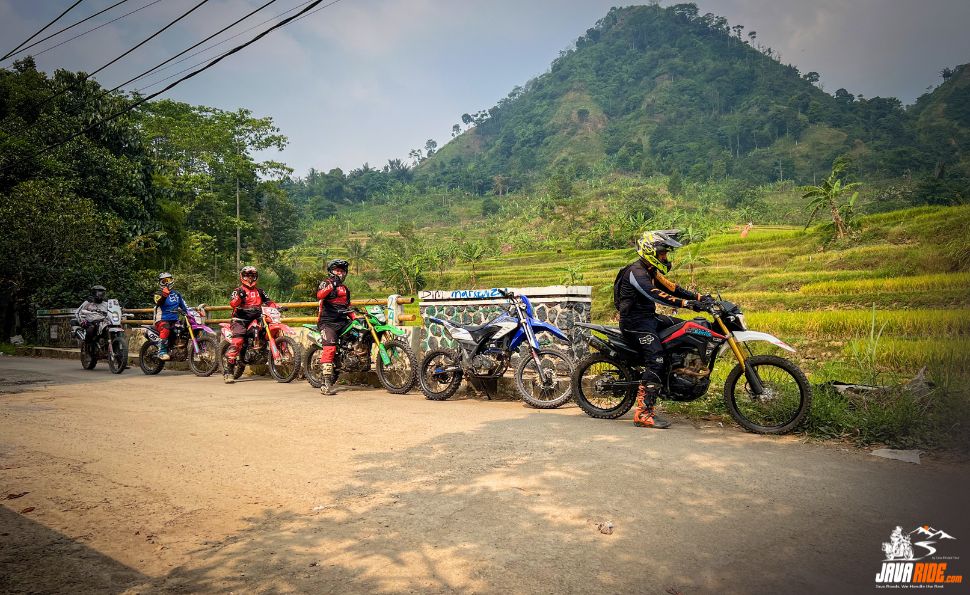
Village roads through rice country are often single-lane with irregular edges — beautiful to look at, brutal to shoot from a chase position because there’s no room to hold a stable following distance without crowding the rider in front. Broken or patched tarmac also transmits vibration straight through a handlebar mount, and a gimbal can only smooth out so much before you lose detail in the highlights.
Wider provincial roads solve most of this: room for a support rider to sit off to one side for a clean three-quarter angle, better surface consistency, and usually enough shoulder for a static tripod setup. The trade-off is more traffic, which makes timing the variable you’re managing instead of road geometry.
Building a Day With Real Visual Range
A single-location route gets repetitive fast — viewers can tell within thirty seconds if a ride is one texture stretched over ten minutes. Java’s advantage is that a well-built day can move through genuinely different terrain without long transfers: rice country early, a climb into cooler highland air by mid-morning, a descent toward the coast by afternoon. Each stretch has a different light behavior — flat green geometry in the lowlands, contour and mist in the highlands, open horizon and harder light near the water. The mistake is chasing a shot list instead of reading what the terrain and the clock will actually give you that day; among motorcycle routes for motovlogging, the ones that hold up are planned around visual range, not just distance — that’s what makes an edit feel like it covers a real day instead of one long straight road.
Where You Can Actually Stop and Set Up a Shot
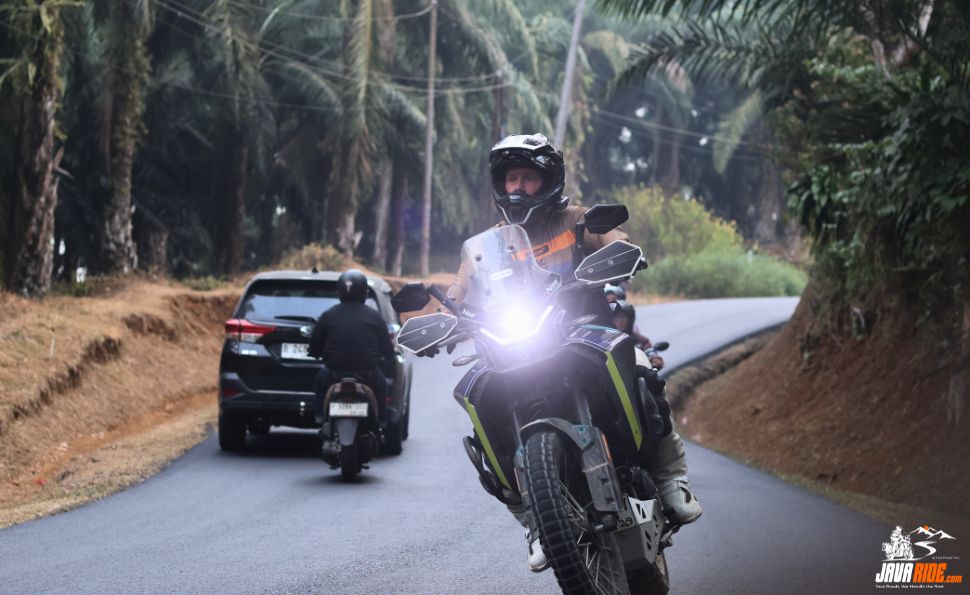
The best-looking stretch of road is worthless for content if there’s nowhere safe to stop. Blind bends, narrow shoulders, and stretches with no run-off are fine to ride through but bad to set up on — you end up skipping the shot or setting up somewhere genuinely unsafe with traffic coming around a corner. What you actually want are wide, visible pull-offs: a warung with space to park off the road surface, a lookout with room for more than one bike, a junction wide enough that a support vehicle can sit as a visible buffer while you get the shot — which is also where a support vehicle stops being a convenience and starts being part of the shoot itself, holding position as a safety buffer or carrying the gear that makes a proper stop possible.
The Traffic Variable Most Rider-Vloggers Ignore
Market towns and school zones have predictable congestion windows — usually mid-morning and again in the late afternoon — and riding through them at the wrong hour doesn’t just slow you down, it fills your audio track with horns and idle engine noise you’ll spend hours cutting around in the edit. A route that looks identical on a map can film completely differently depending on whether you pass through a town at 7am or 11am. Building a shoot day around this — not just around distance and food stops — is the difference between clean pass-through footage and a clip you have to rescue in post.
Riding It With Someone Who Reads the Route Like This Already
Scouting motorcycle routes for motovlogging is hard to do alone, especially on a first trip to Java: knowing which roads run the right direction for your light, which stretches have real pull-off room, and which town you need to clear before 9am. That’s exactly where a JavaRide road captain earns their keep — not just plotting a riding schedule, but adjusting departure times, rest stops, and pacing around when the light and the road actually work for a camera, because they’ve ridden these routes enough times to know both versions of them.
Every JavaRide trip is fully-supported from start to finish — motorcycle, gear, a support vehicle, a towing vehicle, and a mechanic on every route, so a flat tire or a mechanical issue doesn’t cost you the light you built your whole day around. Every trip is also private and built around who’s actually riding: a solo creator working alone, a group of friends splitting shooting duties, a corporate outing, or a visiting motorcycle club that would rather not deal with shipping bikes into the country. Road captains who know the terrain, the weather patterns, and the communities along the way plan around all of it, backed by more than a decade of Java Private Tour’s operational experience across Java, Bali, Lombok, and Flores.
We’re not a generalist operator spread thin across the whole archipelago — we’re a Java specialist, with the route depth and local community access that a generalist simply doesn’t build up. For a production crew or a solo rider building a channel on a first trip to Java, that’s the difference between guessing at logistics and terrain alone, and having someone who’s already solved both.
So, if you’re ready to ride the routes that actually work for the channel, head over to our contact page and let’s start planning your route. Or you can simply CLICK THIS LINK to chat with us on WhatsApp. With JavaRide, you’re not just getting a bike and a route — you’re getting fifteen years of local knowledge behind every mile. See you on the road!